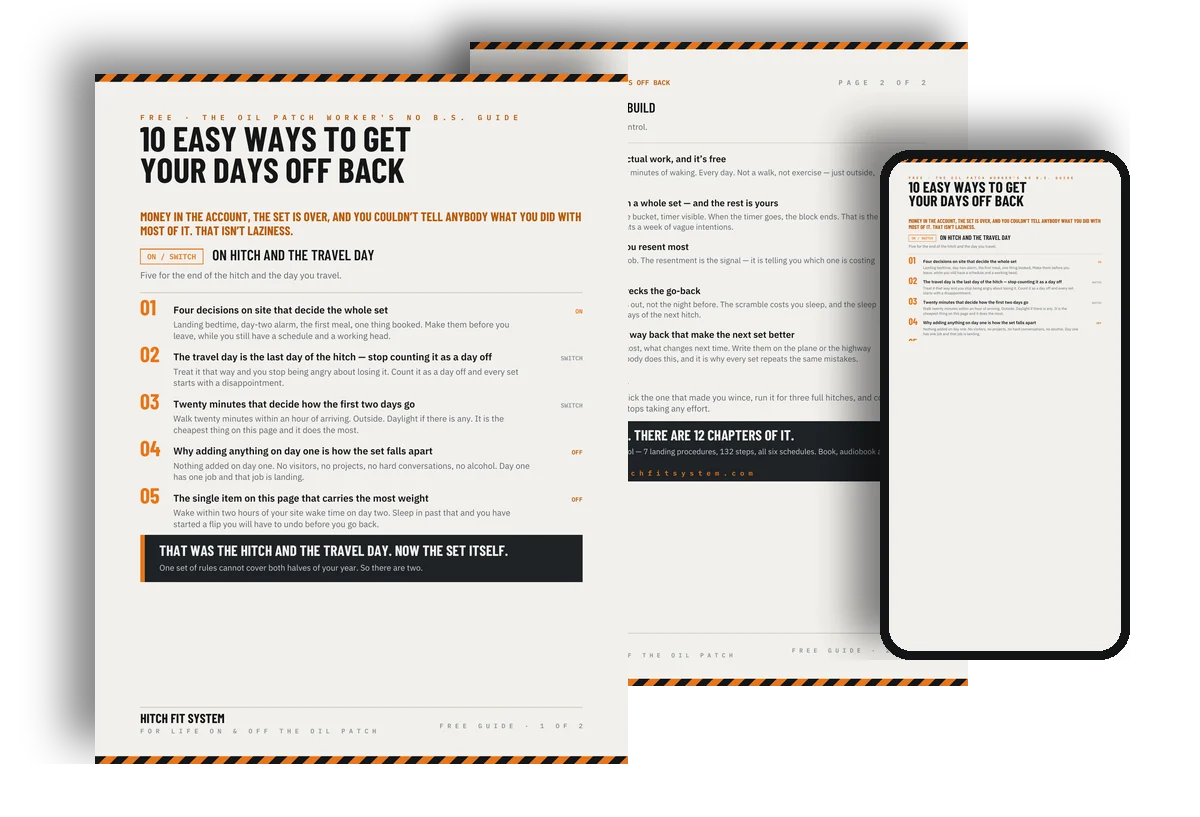
Get More Stuff Done On Your Days Off…
A tactical blueprint for oil patch rotational workers to control their days off, eliminate post-shift lag, and execute major life goals every single set of days off.
Works on your very next set of days off · Ten minutes of setup · Built for 4&3 through 21&7
RE: Why your days off keep disappearing with nothing to show for them
You know the moment I'm talking about.
You're on the bus. Or you're at the gate. Going back in. And you're running the list in your head — the one you brought home with you.
The truck still needs brakes. The appointment never got booked. The deck is still not stained. The birthday present is still sitting in a shopping cart on your phone.
The shop you were going to build. The ticket you were going to get. The offer you were going to put in.
All of it is exactly where it was when you landed.
"Where did that go?"
You had the time. That's what makes it worse.
You didn't have a busy schedule and a boss and a commute eating your evenings. You had days. Whole days. With nothing on them.
And somehow the list came home with you, sat in the next room for the whole stretch, and went back to site untouched. Then you do it again. Twenty-six times a year.
You already know this. Seeing it written down does something.
Land wrecked. Sleep twelve hours. Wake feeling worse than when you went down. You tell yourself you're catching up. You're not — you're pushing the clock further out, which makes tomorrow worse.
Not because nothing happens. Because almost nothing happens. You never actually relax, because the list is always there. And you never finish anything, because you never really start.
Suddenly it's day nine and the brakes are still shot. Errands at a dead sprint, in a bad mood, snapping at people who did nothing wrong. You get a third of it done.
You go quiet. Get short. Already back on site in your head. Then packing at midnight, up at 4am already in a hole — so the front of your next hitch runs on fumes too.
Three at the front, three at the back. Neither worked nor lived — just burned in transition. On two-and-two that's roughly five months a year.
But the lost days aren't the expensive part. The list isn't really a list. It's the shop that never got built. The certification that would have moved you up a band. The rental you looked at twice and never made an offer on. Those don't sit still. They expire.
You are not an undisciplined person. Up at 4:30 with no snooze. Twelve hours at minus forty. Twenty-step lockouts where missing one gets somebody hurt. So why can't that same person book a dentist appointment in fourteen days at home?
Site discipline never comes home. Because it was never your discipline — it was the site's structure.
And structure doesn't fit in a bag.
On site every decision is made for you. At home a depleted brain gets forty a day and refuses. So the decisions get made on site, in ten minutes, before you fly.
Spread across the whole stretch, no day is free and no day is productive. Grouped into dense two-hour blocks, the list dies in two mornings and the rest stays empty.
Five goals alive at once finishes zero. One goal, ninety minutes a morning, moved every time you come home — that finishes the shop, the ticket, the deal.
Researchers have studied rotational and fly-in fly-out workers for years, measuring on-shift and off-shift behaviour separately. Some of it is not what you'd guess.
They're where drinking does. In a study of rotational mining workers, risky-level drinking was reported at nearly 58% during days off — against about 34% on shift. Nearly double. Same workers, same month.
Struggling with the switch between work mode and home mode was linked to heavier drinking. Not weaker workers — workers who found the switch hard and had no system for it.
Workers who felt more control over their time off drank less. More say. More choice. More sense the time belonged to them. That's a measured finding — and it's what this system is built on.
This is not really about getting more done. It's about getting control back.
The jobs getting done is a side effect. Control is the product.
Every productivity system assumes your Tuesday looks like your Saturday. Yours doesn't — and neither does the next person's.
Somebody coming off 21 days carries far more sleep debt than somebody coming off 4. Give them both 7 days off and only one of them has room to pay it back and still have a life.
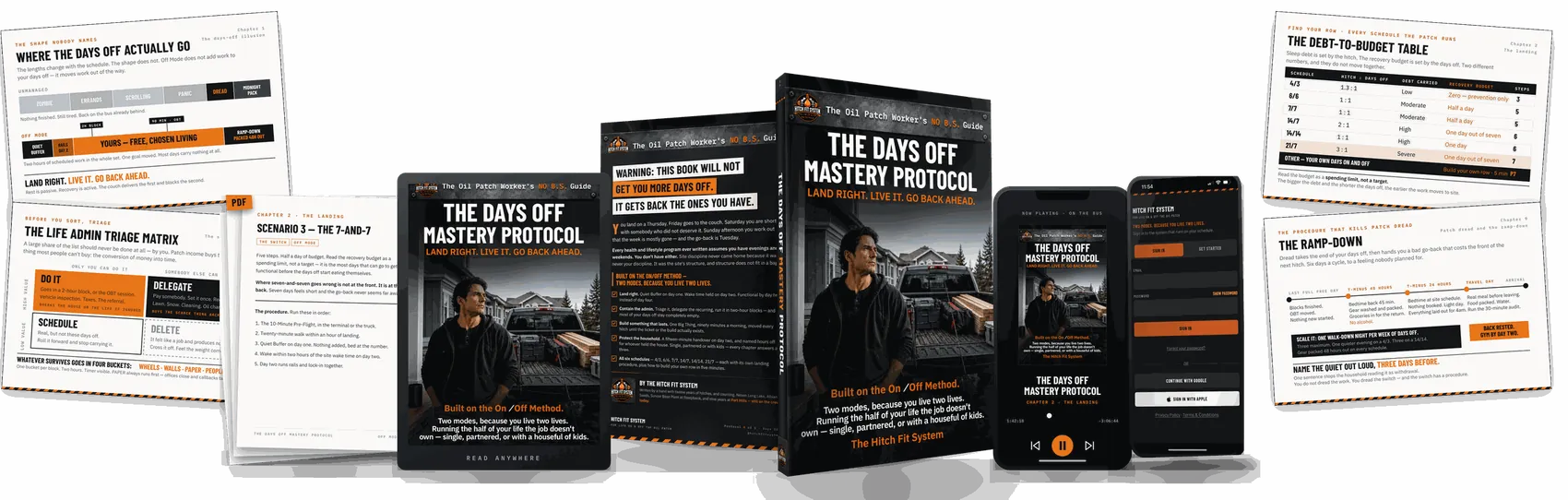
That's the Debt-to-Budget Ratio, and it's why this book contains five separate landing protocols instead of one generic list pretending every rotation is the same.
Run 21-and-7? Nobody has ever written you a plan. There's a full seven-step protocol inside for you specifically — including a step that exists on no other rotation.
| Rotation | Ratio | Recovery budget |
|---|---|---|
| 4 and 3 | 1.3 : 1 | Zero days — prevention only |
| 6 and 6 | 1 : 1 | Half a day |
| 7 and 7 | 1 : 1 | Half a day |
| 14 and 14 | 1 : 1 | One day |
| 21 and 7 | 3 : 1 | One day out of seven |
Plus day-by-day templates for 8&6, 14&7 and 20&8 — and a rule for working out any rotation not listed.
Not Day 4, not Day 5. The fog stops eating the front of every stretch.
Vehicle, house, calls, appointments, the birthday present — cleared in dense blocks instead of leaking across every day you're home.
On 14 and 14 that's nine empty days. On 7 and 7 it's four. Empty on purpose, with no guilt attached, because the list is already dead.
The shop. The ticket. The offer. The rebuild. Ninety minutes a morning, and it advances whether or not you feel like it that stretch.
Because the thing that causes it gets handled from site, in ninety seconds, before you land.
No midnight packing. No dread eating the end. And you go back rested enough to be useful on Day 2 of the hitch instead of Day 5.
eBook | Audio Book | Hitch Fit App
Every chapter has separate execution steps for single workers, partners without kids, and workers with kids.
Practical steps to take charge of your days off.
88 pages. 11 chapters. 9 appendices. PDF and ePub — reads on a phone in a camp room on bad Wi-Fi.
The whole system, narrated. Run it on the flight, the crew bus, or the drive down the 63.
Rotation-aware. Knows the difference between Day 3 of a hitch and Day 3 of your days off.
Every one is a specific, common failure with a specific fix. None of them need more willpower than you already have.
You land, you sleep, you wake up feeling worse, and by the time the fog lifts a third of your time home is gone.
Instead: you're functional on Day 2. Every set. The fog stops being a tax you pay on arrival.
You white-knuckle it, stay up 24 hours, crash, and spend four days out of step with everyone in the house.
Instead: you pick your flip before you leave site and you're back in sync in about 36 hours.
Never off, never working. The jobs sit in the next room and quietly ruin every hour you're supposedly resting.
Instead: the whole list dies in a couple of two-hour blocks and the rest of your days off are genuinely empty.
The shop. The ticket. The offer. Five goals alive at once, none of them moving, and the same list next set.
Instead: one goal, ninety minutes a morning, moved every time you come home — until it's done.
Nothing on site for two weeks, then it fills the shape your days off don't have. Two nights back to back eats a week.
Instead: the good nights get chosen and calendared — protected, not removed, and not costing you three days of sleep.
You need a few quiet hours. They've run everything alone and have been counting down to help arriving. Nobody said either out loud.
Instead: one message from site and a fifteen-minute conversation on Day 2 — and the driveway argument stops happening.
Snapping at small things. Overwhelmed by noise in your own house. Then feeling like garbage about it afterwards.
Instead: you know the cause, you name it before it lands, and it shrinks to something the household can see coming.
You go quiet. They read it as pulling away. Then packing at midnight and a 4am start with nothing in the tank.
Instead: gear packed 48 hours out, the quiet named in advance, and you arrive rested enough to be useful on Day 2 of the hitch.
Convenience food, jobs paid out because you ran out of time, and the day-nine purchase to make wasted days off feel like something.
Instead: you know your real monthly number, and days off with a plan stop generating the spending in the first place.
Counted four or more? Then none of this is a discipline problem — and all nine have a fix.
Every one of these is printable, phone-readable, and built for a camp room with bad Wi-Fi.
A complete landing protocol for 4&3, 6&6, 7&7, 14&14 and 21&7, each sized to your Debt-to-Budget Ratio.
Never wonder again whether your days off are actually getting better — the app shows you the trend.
Rotation-aware plans, scorecard tracking, and a Pre-Flight reminder that fires while you are still on site.
80+ real patch tasks pre-sorted into Wheels, Walls, Paper and People. Safety tickets, LOA reconciliation, block heater cords, undercarriage rinses.
Your ratio, budget, protocol, block count, biggest risk and priority reading — on one page.
Written to the person at home, not to you. Hand it over and stop having the same argument every stretch.
Every common failure answered, so one bad stretch doesn't end the system.
Print it, pin it inside the camp room door. Ten minutes before you fly and the whole stretch is decided.
Nine points, tracked across six stretches on one page. Because invisible progress is what kills systems.
What to run on your first three stretches, so you actually stick with it. A partly-run system beats an abandoned one.
Every system in this book dies the same way — not from being wrong, but from being invisible.
Ask anybody on the bus how their last set of days off went and you'll get "fine, went fast." That's not data. Without a record there's no trend, and without a trend there's nothing to improve.
Thirty minutes on the bus is the part that compounds — and it's the first thing that goes when you're wrecked. Then the ONE change you picked last time is forgotten before you land.
The Pre-Flight is printable — but the moment it matters most is in a terminal at 8pm with a bag on your shoulder. The checklist you need is the one already in your pocket.
Scorecard · up from 4/9 last set
Day 3 of a hitch and Day 3 of your days off need opposite things. The app tracks your rotation and shows the right protocol on the right day — automatically.
The Pre-Flight is worthless if you remember it after you land. The reminder fires while you're still on site, when the ten minutes actually buy you something.
Nine-point scorecard, tracked across every set of days off, with the trend on one screen. The number matters less than the direction — and the direction is invisible without a record.
The shop, the ticket, the offer — logged session by session, so momentum survives the two weeks you're away and you never restart from a blank page.
You picked it on the bus. The app puts it back in front of you on the last day of the next hitch — which is the entire point of running an audit at all.
Works on site with no signal. Syncs when you get bars.
So don't. The entire system is narrated — and the oil patch is the single best place on earth to listen to something.
A twelve-hour shift ends and nobody opens a book. You get back to the room, you eat, you scroll, you sleep. That is not a discipline failure — it is what a body does after twelve hours on the deck.
So the book sits unread on the phone for three hitches, and the system inside it never gets a chance to work. That is the single most common reason a good plan does nothing.
The crew bus. The terminal. The flight. Five hours on the 63. Walking to the shop. The gym in camp. Doing laundry on a Sunday night.
That time is already yours and it is currently worth nothing. Listening turns it into the one stretch where the whole system gets into your head — before you ever land.
Two hours in the air is enough to run the whole Re-Entry chapter and land already knowing your protocol.
Five hours of highway is more than the entire book. Commuters get through it in a single changeover day.
Going off nights this hitch? Play the Sleep Flip chapter on the bus in. It costs you nothing you were using.
Hand them the earbuds on a drive. Half the friction at home comes from one person having context the other doesn't.
The blunt one. A book you listen to on time you were wasting anyway is a book that actually gets finished.
Download for offline. No signal needed at site.
| The Days Off Mastery Protocol eBook — 88 pages, PDF + ePub | $97 |
| The Days Off Mastery Audio Book — the full system, narrated | $47 |
| The Hitch Fit App — rotation-aware plans, scorecard tracking, Pre-Flight reminders | $150 |
| The Five Rotation Protocols | $47 |
| The Task Vault — 80+ pre-sorted tasks | $47 |
| The Rotation Finder | $37 |
| The Partner Page | $37 |
| The Troubleshooting Vault | $37 |
| The 10-Minute Pre-Flight Checklist | $29 |
| The Days Off Scorecard | $27 |
| The Build Order | $27 |
| Total Value | $582 |
Instant PDF + ePub + App access · 60-day full refund · Keep everything
60-Day Site-Tested Guarantee
Download it. Run Days Off One of the Build Order on your very next stretch home. That's the landing protocol — ten minutes on site, a walk, a protected first day, and an early wake on day two.
That's the whole test. One stretch.
If your days off don't look meaningfully different from the last set — email support inside 60 days and I'll refund every cent. No form. No phone call. No explanation required.
And you keep the book and every bonus anyway. I'm not going to chase anybody for a PDF.
I'm asking you to test a procedure on the job. If it doesn't hold up on the job, you shouldn't pay for it.
The first thing in this book takes ten minutes in a terminal and pays off within 48 hours of landing.
Instant ePub and Audio Book. On your phone before you leave the checkout page.
iOS and Android. Works on site with no signal, syncs when you get bars.
Enter your rotation. It sets your ratio, recovery budget, block count and protocol.
On the bus, on the flight, in the camp room. One chapter per night shift.
Ten minutes before you fly. Functional by Day 2. Audit on the bus back.
Each book stands alone. Read them in any order.
Body recomposition built around camp kitchens and changeover days.
Read this one →Night rotations and body clock repair, in full detail.
Read this one →Energy, drive and recovery across a long career of shift work.
Read this one →The half of your life nobody ever wrote a plan for.
Without a plan, it goes how the last one went. Three days on the couch. Days of low-grade guilt. A panic sprint. Two days of dread. Then the bus, and that quiet question.
"Where did that go?"
With a plan, it starts with a message you send from site on the last day of this hitch. It takes ninety seconds.
Half of your life happens at home.
Time to run that half on purpose.
$582 value · Instant PDF + ePub + App · 60-day full refund · Keep everything